
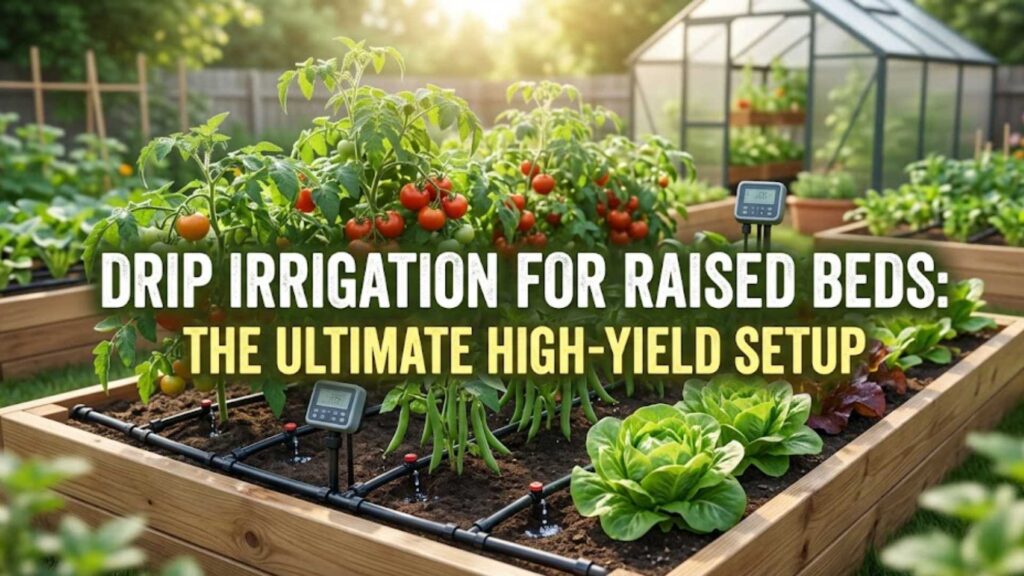
Drip irrigation for raised beds is an exceptionally effective watering method that delivers moisture directly to the root zone, saving up to 50% more water than traditional overhead methods while significantly reducing the risk of fungal diseases. If you are tired of the daily chore of hand-watering or watching your utility bill climb during a dry US summer, an automated drip system is the single best investment you can make for your garden’s productivity.
As a Raised Bed Expert who has designed irrigation layouts from the humid hills of North Carolina to the scorched plains of Arizona, I can tell you that “consistency” is the secret ingredient to those massive, prize-winning harvests. Plants don’t like a “flood and famine” cycle; they want steady, reliable hydration.
*This video was created using NotebookLM, based on my review content, so you can listen instead of reading.
1. Why Drip Irrigation Works So Well for Raised Beds
Raised beds are essentially large containers. Because they are elevated and filled with porous soil (like my recommended 40/30/20/10 mix), they drain much faster than the surrounding earth.
- Targeted Saturation: Drip emitters release water slowly, allowing it to “bloom” horizontally beneath the surface. This ensures the entire root ball is hydrated without wasting water on the paths between your beds.
- Minimized Evaporation: In high-heat regions, overhead sprinklers can lose up to 30% of their water to evaporation before it even hits the soil. Drip delivers water under the foliage, keeping the “sun-to-water” contact at a minimum.
- Disease Control: Many pathogens, such as early blight in tomatoes, are spread by water splashing soil onto the leaves. Drip keeps the foliage dry, creating a hostile environment for mold and fungi.
2. Pros and Cons of Drip Irrigation ⚖️
Before you buy a kit, you need an honest assessment of what you’re getting into.
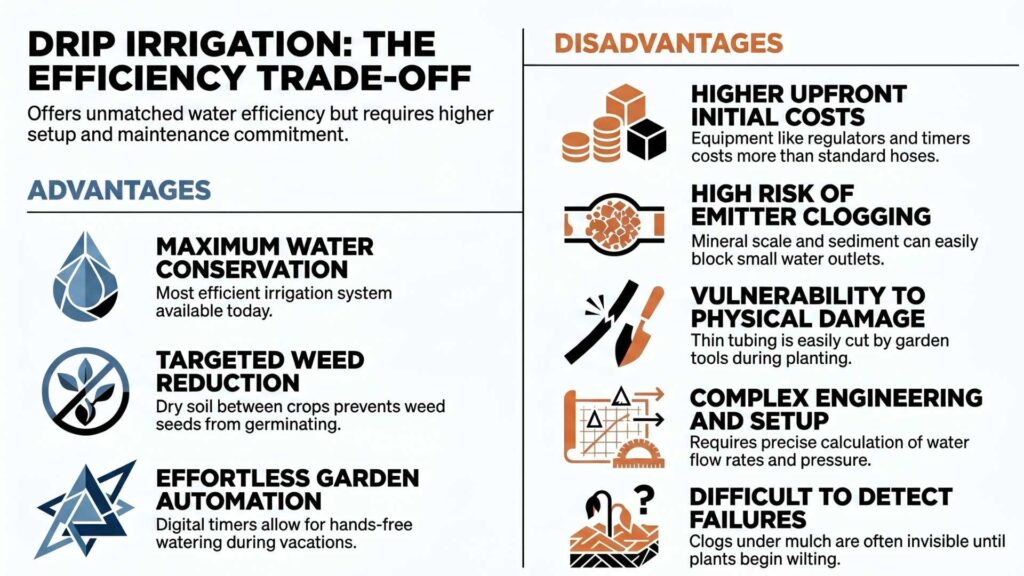
The Advantages (Pros)
- Water Conservation: It is the most efficient system on the market, period.
- Weed Reduction: By only watering your crops, the weed seeds in the dry areas between plants fail to germinate.
- Automation: Pair it with a $40 digital timer, and your garden waters itself while you’re on vacation.
The Disadvantages (Cons)
To answer the common search query regarding the 5 disadvantages of drip irrigation:
- Higher Initial Cost: You’ll spend more upfront on tubing, regulators, and timers than you would on a simple hose.
- Clogging Risks: Small emitters can be blocked by mineral scale or fine sediment if you don’t use a filter.
- Physical Vulnerability: It is easy to accidentally slice through a 1/4-inch line with a garden trowel during planting.
- Setup Complexity: It requires a bit of “garden engineering” to calculate flow rates and pressure.
- Invisible Failures: Because the lines are often hidden under mulch, you might not notice a clog until a plant begins to wilt.
3. Types of Drip Systems for Raised Beds
- Drip Lines (The Pro Choice): These are 1/2″ or 1/4″ tubes with emitters pre-installed inside the pipe every 6 or 12 inches. They are durable and perfect for grid-style planting.
- Soaker Hoses: These “sweat” water along their entire length. They are cheap but notoriously inconsistent; the beginning of the hose gets way more water than the end.
- Individual Emitters: Best for irregular spacing. You punch a hole exactly where your pepper plant is and run a dedicated line to its base.

4. How Many Drip Lines for a 4×8 Raised Bed? ⭐
One of the most frequent questions I get is: How many drip lines for a 4×8 raised bed?
For a standard 4-foot wide bed, you need 3 to 4 parallel drip lines running the 8-foot length of the bed.
- Spacing: Lines should be placed approximately 12 inches apart.
- The Logic: Most garden soil has a “capillary pull” that spreads water 6 inches in either direction. With lines spaced 12 inches apart, the “wet zones” will overlap perfectly, ensuring no dry spots in the middle of your bed.
5. The 30-30 Rule Explained
In the irrigation world, we use the 30-30 Rule as a baseline for deep-root hydration.
- 30 Minutes: This is the average runtime for a standard drip system (using 0.5 GPH emitters) to deliver enough water.
- 30 Centimeters (approx. 12 inches): This is the depth the moisture should reach.
Expert Adjustment: If you live in a sandy-soil area (like Florida), you may need to water for 15 minutes twice a day because water moves straight down. If you have heavy clay, 45 minutes once every three days might be better to allow for slow absorption.
6. Step-by-Step: How to Install Drip Irrigation
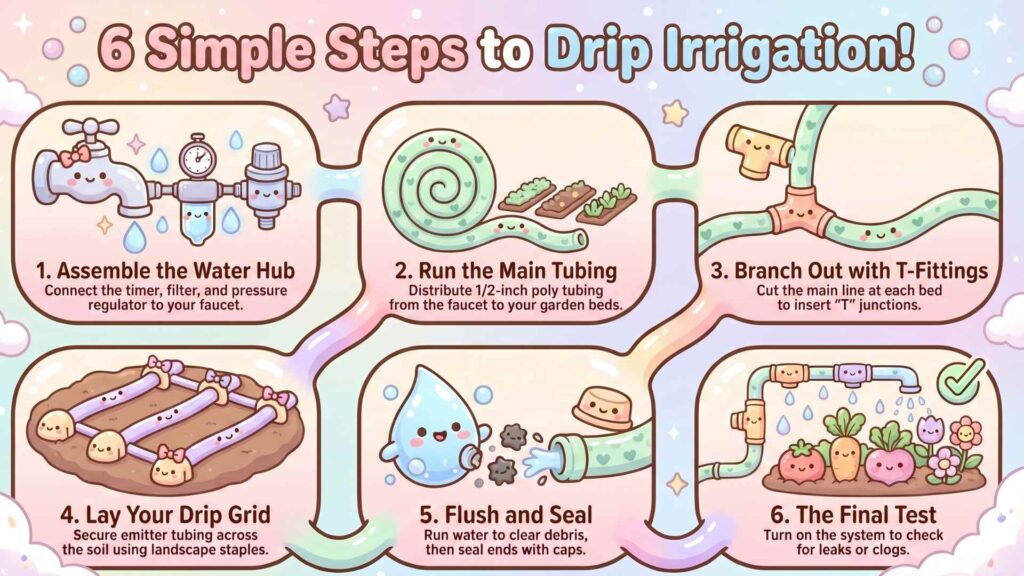
- The Head Assembly: Connect your timer to the faucet, followed by a backflow preventer, a 150-mesh filter, and a 25-PSI pressure regulator.
- Main Line Distribution: Run 1/2-inch poly tubing from the faucet to your beds.
- The “T” Junction: At each bed, cut the main line and insert a T-fitting to run tubing up into the raised bed.
- Layout the Grid: Secure your drip lines (1/4-inch or 1/2-inch emitter tubing) across the soil surface using landscape staples.
- Flush and Cap: Turn the water on for one minute to flush out any plastic shavings, then seal the ends with “Goof Plugs” or end-caps.
- Test: Run the system and look for leaks or clogged emitters.
7. Best Setup for Different Crops
- Leafy Greens (Lettuce/Spinach): Use a tight grid of drip lines (6-inch spacing) because their roots are shallow and widespread.
- Deep Feeders (Tomatoes/Zucchini): I prefer using individual 2-GPH (Gallons Per Hour) emitters placed right at the base of the plant to encourage deep taproot growth.
- Root Crops (Carrots/Beets): Use pre-installed emitter lines (12-inch spacing) to ensure even moisture, which prevents carrots from splitting.
8. Common Mistakes to Avoid ❌
- Skipping the Filter: Even if your water looks clean, tiny particulates will eventually kill your emitters.
- Over-spacing: Placing lines 18–24 inches apart will leave “death zones” in your bed where nothing grows.
- Forgetting the Pressure Regulator: Most home faucets are 60+ PSI. Drip systems are designed for 25 PSI. Without a regulator, your fittings will literally blow apart.
9. Tina’s Expert Evaluation: Cost Breakdown (US Market)
| Component | Basic DIY Setup (1-2 beds) | Professional Full System (4-6 beds) |
|---|---|---|
| Timer & Head Assembly | $35 – $50 | $75 – $120 (Smart Timers) |
| Tubing & Emitters | $20 – $40 | $60 – $150 |
| Total Investment | $55 – $90 | $135 – $270 |
My Take: While a “kit” from a big-box store seems tempting at $30, the components are usually brittle and leak within one season. I recommend buying individual components from professional brands like Rain Bird, DIG, or Netafim. It’s a higher upfront cost, but you won’t be replacing it next year.
Who is this for?
- Ideal for: Homeowners with permanent raised beds, busy professionals, and those in drought-prone states.
- Not for: Renters with one-season containers or those who enjoy the “Zen” of hand-watering every morning.
Conclusion: Your Path to a Maintenance-Free Harvest
Transitioning to drip irrigation for raised beds is more than just a convenience; it is a fundamental shift toward professional-grade garden management. While the initial setup requires a small investment of time and capital, the return—measured in reduced water bills, zero wasted hours with a hose, and significantly higher crop yields—is undeniable.My final recommendation for any home gardener is this: don’t let the technical details paralyze you. You don’t need a perfect system on day one. Start with a basic emitter tubing layout for your most water-hungry beds, learn how your soil responds to the 30-30 rule, and expand your zones as your confidence grows. Within one season, you’ll find that a consistent, automated water supply is the “secret sauce” that turns a struggling backyard plot into a lush, productive sanctuary.